What Is Account-Based Marketing?
Account-based marketing (ABM) is a B2B go-to-market strategy that treats individual accounts as markets of one. Instead of broadcasting campaigns to wide audiences and waiting for leads to self-select, ABM inverts the funnel: you identify which companies you want as customers, then build targeted campaigns designed to engage those specific organizations.
ABM coordinates marketing and sales around a defined account list. Each tactic, whether ads, events, emails, direct outreach, or content, is designed to move specific accounts through the buying cycle rather than generate generic awareness.
The core premise: not all companies in your addressable market are equally worth pursuing. ABM forces discipline around which accounts you invest in, and directs your best resources at the accounts most likely to produce revenue.
How ABM Works in Practice
A typical ABM program operates in five steps.
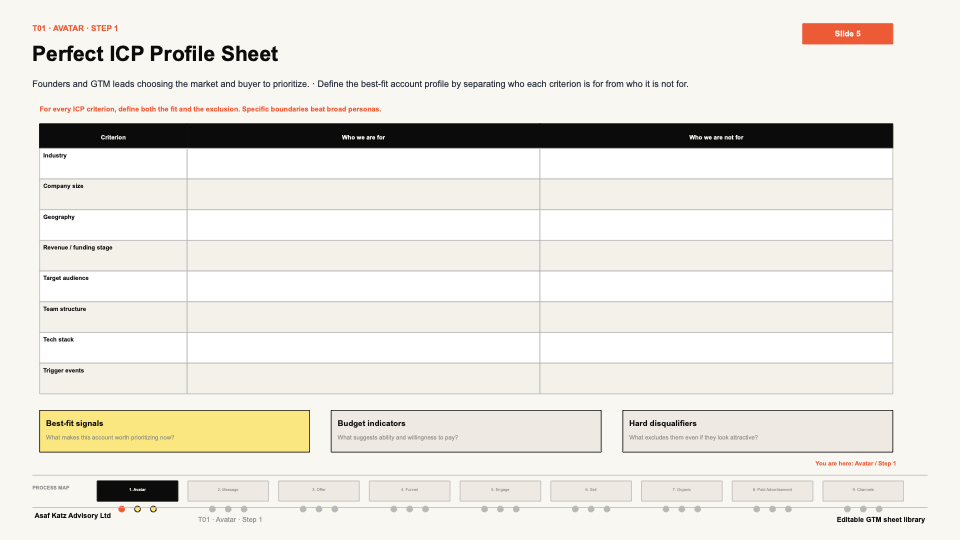
1. Account selection. Define your ideal customer profile (ICP) and build a list of named accounts that fit it best. This is typically 50 to 500 accounts for a focused program.
2. Persona mapping. Identify the key buying personas within each account. Enterprise deals often involve 6 to 10 stakeholders. ABM maps each role and their specific concerns.
3. Account intelligence. Research each account's current situation: recent news, technology stack, hiring signals, regulatory exposure, competitive landscape. This intelligence personalizes the outreach.
4. Coordinated engagement. Run coordinated campaigns across channels where each touchpoint is tailored to the account's specific context.
5. Sales activation. When an account shows engagement signals, sales activates with warm, contextualized outreach that builds on the marketing touchpoints.
One thing I want to flag here: none of these steps work if step one is wrong. I have seen companies run beautifully coordinated ABM programs at the wrong list. The Foundation has to come first. Avatar clarity before campaign execution, every time.
ABM vs. Traditional Demand Generation
Traditional demand generation casts a wide net. SEO, paid ads, content marketing, and webinars attract anyone who might be interested. The goal is volume of leads, with the assumption that a percentage will be qualified.
ABM inverts this. The goal is engagement from specific accounts. If the right companies engage, they are qualified by definition.
The practical difference: demand gen measures leads, MQLs, and traffic. ABM measures account engagement rate, pipeline from named accounts, and meeting rates with target personas.
Live Events as an ABM Channel
Live events are one of the most effective ABM channels because they combine precision targeting with a high-quality engagement signal. When a contact from your named account list attends your live event, you have a verified signal that is more reliable than a web visit or an email open.
From my own work: one AI-regulation webinar pulled 754 signups in 26 days. Over 100 of those came from target accounts. Zero paid ads. The topic was something buyers already wanted to discuss, with a voice they already trusted. That is the combination that makes event-led ABM work.
I have also seen what happens when the invite list is built right. Across hundreds of outreach campaigns, event invites get accepted 40 to 50 percent of the time. Pitch outreach to the same lists gets 5 to 10 percent. The ask is the variable. Invite people to something useful and they show up. Pitch them cold and they disappear.
For teams running named account programs, that acceptance rate difference is significant. It means events are not just a brand play. They are a meeting-generation engine pointed at a specific list.
What event-led ABM can produce:
- 100+ target account attendees from a single event cycle
- 754 total registrations in 26 days from a targeted invitation sequence
- 43 qualified meetings in 60 days including named account opportunities
- Recurring event series running 300 to 800 registrations per event
ABM in 2026: What Has Changed
ABM has matured significantly. A few things worth noting.
AI tools make account intelligence easier to gather at scale. That is real. But AI amplifies whatever is already there, including the broken parts. If your ICP is vague and your message is generic, AI will help you send that message faster to more of the wrong people.
Intent data from platforms like Bombora and ZoomInfo makes account prioritization more precise. Used well, it tells you which accounts are in an active buying motion right now. That is useful for sequencing your outreach, not for replacing the judgment of who belongs on your list in the first place.
Live events have emerged as the highest-converting ABM channel for companies with complex deals and senior buyer personas. The reason is not complicated. A senior buyer who attends your event has self-selected into a conversation. That is a warmer signal than any click or form fill.
The fundamentals have not changed. Know exactly who you want. Build something worth their time. Show up in a way that earns a real conversation.