ABM for DevOps Companies in 2026: How to Reach VP Engineering and Platform Teams
DevOps buyers are among the most skeptical audiences in B2B. VP Engineering, platform engineers, DevSecOps leads, SREs, and CTOs have been marketed to by hundreds of tools. They know what a vendor pitch looks like, and they are very good at ignoring it. Generic ABM campaigns that treat DevOps buyers like any other enterprise buyer fail because they do not account for the trust gap that exists between technical buyers and vendor marketing.
ABM for DevOps generates 2.6x more pipeline per marketing dollar than broad-reach demand gen, with 41% higher win rates when executed correctly. The difference between those who get those results and those who do not is almost always the quality of the personalization and the activation approach.
Why DevOps ABM Is Different From Standard ABM
Standard ABM assumes that personalization means referencing a prospect's company name, industry, or role. For DevOps buyers, that level of personalization barely registers. What actually matters to a VP Engineering is whether you understand their specific stack, their current architectural challenges, and the problem they are trying to solve right now.
Technical buyers trust peers, not vendor marketing. A VP Engineering who reads a case study written by another VP Engineering at a company with a similar stack will engage. The same buyer receiving a generic whitepaper about developer productivity will not. The credibility transfer has to come from someone who has done the work, not from a marketing team that describes the work from the outside.
I learned this the hard way when I sold technology to trucking companies. The most practical buyers on earth. If the value is not obvious in one sentence, the conversation is over. DevOps engineers are the same. They have built things that broke. They know what real problems look like. A message that sounds like it was written by a copywriter gets deleted without a second thought.
DevOps also has longer buying cycles than most software categories. Platform decisions involve multiple stakeholders, evaluation periods, and proof-of-concept phases. ABM for DevOps needs to account for a 6 to 12 month pipeline timeline, with early engagement signals appearing in the first 3 to 6 months and revenue impact in 9 to 18 months.
How to Identify Which DevOps Accounts to Target
Account selection for DevOps ABM is more signal-rich than most categories because technical buyers leave visible traces of their current situation. The strongest signals are:
- Tech stack signals: companies using complementary tools or running a migration off a platform you replace
- Hiring signals: a company hiring three or more platform engineers, SREs, or DevSecOps leads simultaneously is building or rebuilding their platform
- Platform migration announcements: companies that publicly announce cloud migrations, Kubernetes adoption, or infrastructure modernization are in active buying mode
- Security incidents: a public breach or vulnerability disclosure often accelerates tooling decisions
The best DevOps target account lists are built from multiple overlapping signals, not just job title counts. A company with 50 engineers that is actively hiring three SREs and just posted about migrating to Kubernetes is far more in-market than a company with 500 engineers showing no movement signals.
Firmographic fit still matters: company size, funding stage, and industry determine whether a deal is worth pursuing. But for DevOps, the behavioral and technical signals are what separate in-market accounts from accounts that are the right fit but not yet ready to buy.
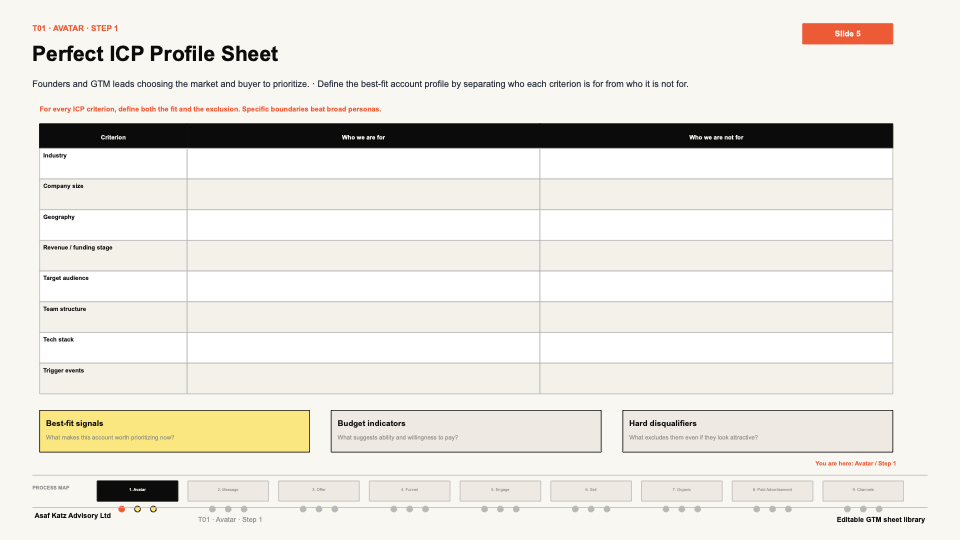
One thing I check before building any target list: is the foundation strong enough to run ABM at all? If the positioning is unclear or the ICP has not been properly defined, better account selection just accelerates rejection. The real stage of your GTM is the lowest true row across product, pipeline, and proof. No one earns the right to run ABM until the foundation holds.
Personalization That Works for VP Engineering
The personalization standard for VP Engineering is high and unforgiving. Messages that feel generic, that use buzzwords without technical specificity, or that lead with vendor claims rather than buyer problems will be ignored or will actively damage your credibility.
What works: stack-specific, problem-specific messaging that starts with what the buyer is dealing with. If you know a company is running Kubernetes on AWS and recently hired two SREs, you can open with a reference to a specific challenge that commonly appears at that stage of Kubernetes adoption. That is not a guess. It is an informed observation that signals you understand their world.
AI is improving the ability to personalize at scale. 29% of ABM practitioners cite AI-powered content personalization as their top use case in 2026. For DevOps, this means generating stack-specific messaging variants for different technical audiences without requiring a human to research each account from scratch. The caution I would add: AI amplifies whatever exists, including the broken parts. If your core message is weak, AI just produces more weak messages faster. Fix the message first.
Avoid: buzzwords like digital transformation, innovation, or synergy. Avoid: claims that are not specific. Faster, better, more efficient mean nothing without a number and a context. Avoid: leading with company history or awards. DevOps buyers do not care.
Using Events as the DevOps ABM Activation
The event that works for DevOps buyers is the practitioner webinar, where real engineers discuss a real technical challenge. Not a product demo. Not a panel of executives. A session where someone who has actually done the work walks through what they tried, what failed, and what worked.
From my own work: one AI-regulation webinar pulled 754 signups in 26 days, with 100+ from target accounts, zero ads. The reason it worked was not the promotion. It was the topic selection. A subject buyers already wanted to discuss, with a voice they already trusted. The same principle applies to DevOps. Kubernetes cost optimization at scale will outperform any webinar titled "Introducing Our Platform."
For DevOps, strong event topics include: real-world Kubernetes cost optimization at scale, platform engineering team structure for companies scaling past 100 engineers, DevSecOps integration without slowing deployment velocity, and incident response automation that actually works in production. The specificity of the topic is what determines the quality of the audience.
Across hundreds of campaigns, event invites get accepted 40 to 50 percent of the time. Pitch outreach to the same lists gets 5 to 10 percent. The ask is the variable. For DevOps accounts, that gap is even wider because engineers will hard-delete anything that smells like a sales motion.
Even 100 attendees from target accounts is a material pipeline opportunity, because each one has self-selected into a topic directly related to your product category.
The Follow-Up Playbook for DevOps Accounts
Event follow-up for DevOps ABM has to be fast and specific. Within 48 hours of the event, the follow-up goes to every attendee who stayed for a meaningful portion of the session. The message references something specific from the event, connects it to the attendee's likely situation, and makes a low-friction ask: a 20-minute technical conversation, not a demo.
The accounts to prioritize are those that showed highest engagement: stayed for the full session, asked questions in chat, downloaded resources, or had multiple contacts from the same company attend. Multi-contact engagement from a single account is one of the strongest ABM signals available. It suggests the topic reached more than one decision-maker.
For DevOps accounts that did not attend but showed other intent signals, share the event recording with a note about why the topic is relevant to their current situation. This is a lower-friction way to get technical buyers engaged with your perspective without immediately asking for a meeting.
Accounts that engage with the recording and then show additional intent signals move to a direct outreach sequence. The sequence is short, specific, and peer-toned rather than salesy. I have seen founders pause campaigns entirely because the humble, no-pitch approach generated more replies than their team could handle. That is a good problem. It happens when the follow-up feels like a continuation of a conversation, not the start of a sales cycle.
The DevOps ABM Motion: Three Phases
The event-led ABM motion works for DevOps companies for a specific reason. It is built around identifying what buyers care about and creating genuine value before the sales conversation. That is exactly what technical buyers require before they will talk to anyone.
The motion works in three phases:
Phase one: Identify 150 to 300 target accounts using the signal criteria described above. Prioritize accounts that show two or more overlapping signals.
Phase two: Build a practitioner event around a topic that is directly relevant to the challenge those accounts are facing right now. The speaker should be a practitioner with a real story, not a vendor evangelist with a slide deck.
Phase three: Follow up with the most engaged accounts within 48 hours. Let engagement drive prioritization, not assumption.
The result is a pipeline built from accounts that already know you, have received value from you, and have self-selected their interest. For DevOps buyers with high skepticism and long buying cycles, that starting position is materially better than any cold ABM approach.
I have helped more than 40 companies rebuild their positioning and GTM motion from this foundation. The ones that shortcut phase one, going straight to outreach or events before the ICP and message are clear, consistently underperform the ones that do the foundation work first. DevOps ABM is no different. Get the target account list and the message right before you run anything.
Take the free 60-second check