What Replaces Cold Email in 2026? The B2B Pipeline Playbook
Cold email is not dead, but it is no longer a primary pipeline channel. The average reply rate hit 3.43% in 2026 according to Instantly's benchmark data, the lowest ever recorded. At that rate, you need to send 3,000 emails to get 100 replies, and most replies are not interested. The structural causes are clear: inbox filtering is smarter, buyers have more options, and generic outreach is everywhere.
Here are the five channels that are replacing cold email as the core of the B2B pipeline playbook.
Why Did Cold Email Stop Working?
Cold email failed because it became a commodity. When every SDR team has access to the same data, the same sequences, and the same templates, differentiation disappears. Buyers learned to ignore batch-and-blast outreach because 95% of it was irrelevant to their actual situation.
The deeper problem is timing. Cold email assumes the buyer is ready to talk now. Most are not. Signal-based approaches work because they reach buyers when the signals say they are actually in-market, which changes the entire dynamic of the conversation.
I learned this the hard way selling door to door. No brand, no inbound, just a doorbell and an offer. The only thing that kept the door open was relevance. If what I said did not connect to something the person already cared about, the door closed. Cold email has the same physics, and most teams are still ignoring them.
Inbox filtering has also accelerated the problem. Gmail and Outlook now route cold outbound to spam or promotions at unprecedented rates, meaning a significant percentage of your sends never arrive. You are paying to send emails that no one reads.
Channel 1: Signal-Based Outbound
Signal-based outbound means reaching out only when a buying signal fires. A company just hired a new VP of Sales. A prospect just posted about a problem your product solves. A company raised a Series B and is scaling the team. These are signals that indicate a buyer may be ready.
Reply rates for signal-based outbound run 15 to 25%, compared to 3.43% for cold email. The reason is simple: the outreach is relevant to something that just happened in the buyer's world. The message feels timely, not random.
The tooling to execute this has matured. Intent data platforms, job posting scrapers, LinkedIn activity monitors, and funding trackers give sales teams a live feed of signals they can act on within hours of a trigger.
From my own work: we tracked posts that our buyers' influencers wrote, harvested 1,175 engaged profiles from 45 posts, and opened 116 conversations at a 45.2% connection acceptance rate. The outreach worked because it was tied to something the prospect had already publicly engaged with. That is signal-based outbound at its simplest, and it beats any template sequence I have ever tested.
Channel 2: Event-Led Motion
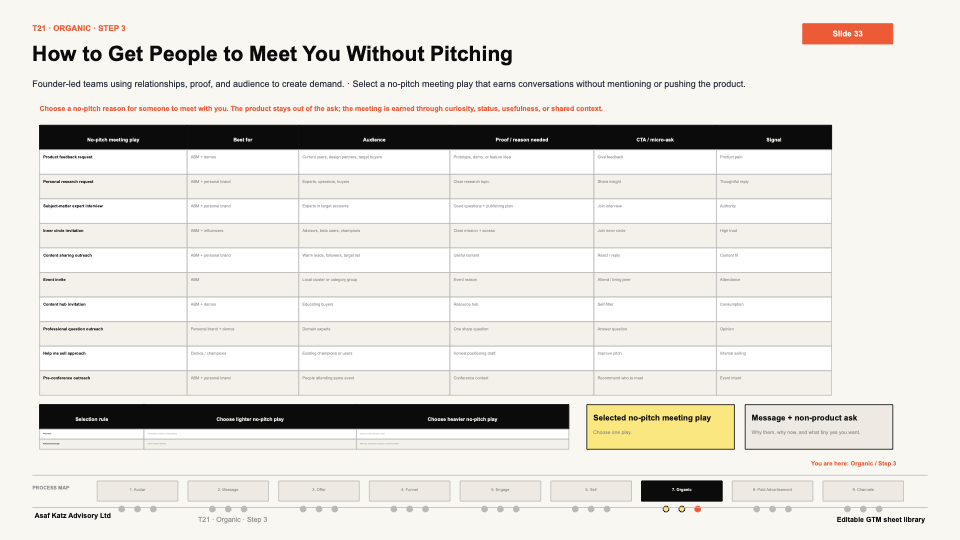
The event-led motion is the highest-quality replacement for cold email because it inverts the entire relationship. Instead of interrupting buyers with a pitch, you invite them to something genuinely useful: a webinar, a roundtable, a peer discussion on a topic they care about.
Buyers who attend your event are self-selecting their interest. They registered, showed up, and stayed. That is the strongest possible buying signal you can get without a discovery call. When you follow up with an attendee, you are not cold outreach. You are the host following up after a valuable conversation.
The numbers I have seen back this up. Event invites get accepted 40 to 50% of the time. Pitch outreach on the same lists to the same senders gets 5 to 10%. The ask is the only variable. My own live show, Risk Takers, draws 460 to 577 live senior attendees per episode, built from zero. One AI-regulation webinar I ran pulled 754 signups in 26 days, over 100 from target accounts, zero ad spend, and generated $180K in pipeline. The multiplier was topic selection: a subject buyers already wanted to discuss, with a voice they already trusted.
The motion works because it identifies what ICP buyers actually care about, builds an event around that topic, and invites target accounts to attend as guests rather than prospects.
Channel 3: LinkedIn DM With Context and Buying Signals
LinkedIn DM is not a replacement for cold email if you use it the same way: mass-sent, template-driven, generic. But when combined with a real buying signal and genuine context, LinkedIn outreach has materially higher response rates than cold email.
The formula is: signal plus relevance plus short ask. You saw that a prospect commented on a thread about a problem you solve. You noticed their company is hiring for a role that suggests they are about to have a specific challenge. You share something useful first, then ask for a conversation. The context is what makes it work.
At RSA one year, one person with no booth and no brand booked 38 C-level meetings from 1,266 prospects using 12-word openers and role-matched senders. Technical founder to AppSec leads. CEO to CISOs. 519 connections, 161 conversations. The principle is the same on LinkedIn: match the sender to the reader, lead with something relevant, keep the ask small.
LinkedIn also has the advantage of being a professional context where buyers expect relevant outreach. Email inboxes are more hostile because buyers have been trained to ignore them.
Channel 4: Warm Referrals and Peer Introductions
Referrals have always worked. What has changed in 2026 is that they are now a structured motion, not an accidental one. Formal referral programs, partner networks, and community relationships are being built deliberately to generate introductions.
A peer introduction converts at 4 to 5 times the rate of cold outreach because trust is pre-transferred. The referred buyer already believes you are credible because someone they respect vouched for you. The first conversation starts at a completely different baseline than cold outreach.
Building a referral motion requires investing in customer success, community participation, and partner relationships before you need the pipeline. It is a slow build but the highest-converting channel once it is running.
Channel 5: ABM With Account-Level Intent
Account-based marketing with intent data means concentrating resources on the accounts that show the strongest signals of in-market behavior. Instead of trying to reach 10,000 companies with the same message, you identify 200 high-fit accounts and run a coordinated, multi-channel motion across each one.
ABM generates 2.6 times more pipeline per marketing dollar than broad-reach demand gen. The combination of account selection, personalized messaging, and multi-channel coordination means you are reaching the right people with the right message at the right time. That is everything cold email is not.
For a global payments enterprise, we booked meetings with brands like Apple, Levi's, and Nespresso using 1,424 connection requests, a 24.8% acceptance rate, native-language outreach in Spanish, Polish, Romanian, and Czech, and landed 6 enterprise meetings at under $40 each. The industry average for comparable meetings runs $300 to $1,500. Tight account selection and coordinated multi-channel work made the difference.
Why Event-Led Motion Is the Primary Answer
The event-led motion is not just a replacement for cold email. It is a fundamentally different way of generating pipeline. Cold email pushes. Events pull. When you host an event that buyers find genuinely useful, they come to you, self-qualify through attendance, and arrive at the follow-up conversation already warm.
61% of B2B buyers prefer rep-free buying. They want to learn before they talk to sales. Events give them exactly that. They get education and peer perspective without a sales pitch, and when they are ready to talk, they are far more likely to engage with the host than with a cold sender.
73% of B2B marketers rate webinars as the best channel for high-quality leads. The combination of self-selection, engagement data, and follow-up context makes events the highest-signal, highest-conversion channel available.
How to Transition Away From Cold Email Dependency
The shift is not about stopping cold email entirely. It is about reducing dependence on it as a primary motion. The practical path is to add one high-quality channel at a time: start with signal-based triggers to improve cold email relevance, then layer in an event-led motion to create inbound pipeline, then build the referral and ABM layers over time.
One note on sequencing: none of these channels work well if the foundation is broken. I have seen teams pour budget into events and ABM while their ICP definition was vague and their offer was unclear. The result is volume without conversion. Fix the avatar and the message first. Then scale the channel. AI tools amplify whatever exists, including the broken parts, so stage calibration matters before anything else.
The sales teams that win in 2026 are the ones that create genuine value before the sales conversation starts. Events, content, community, and peer introductions all do this. Generic cold email does not.
Take the free 60-second check