What Is a GTM Engineer?
A GTM (go-to-market) engineer is a technical revenue professional who builds, automates, and optimizes the systems that power a company's sales and marketing motion. They sit at the intersection of data engineering, sales operations, and growth. Their job is to make the revenue process work at scale without adding headcount linearly.
The role emerged from a specific problem: the explosion of AI tools, enrichment platforms, and CRM capabilities created systems that are too complex for non-technical operators to build and too revenue-focused for traditional engineers to prioritize. GTM engineers fill that gap.
A GTM engineer is not a salesperson. They are the person who builds the system that makes salespeople more effective.
Why Did This Role Emerge in 2026?
Three forces converged to create the GTM engineer role.
First, AI automation made it possible to run enrichment, scoring, and outreach sequences at a scale that previously required large SDR teams. Second, the data stack for B2B revenue became genuinely complex. Clay, Apollo, CRM systems, attribution models, enrichment waterfalls, and scoring models require real technical skill to build and maintain. Third, companies recognized that AI automation fails without clean input data, which required someone who could build reliable, governed data pipelines.
LinkedIn job postings for GTM engineers exceeded 3,000 in January 2026, with hiring more than doubling year over year for two consecutive years. The median salary has reached $127,500, with top employers paying significantly more: Vercel at $252,000, OpenAI at $250,000, and Ramp at $184,000.
The hiring surge reflects a structural shift in how B2B revenue teams are built. Companies are investing in systems and automation infrastructure rather than headcount.
I have watched this shift up close. Across 35+ companies I have helped that collectively raised over $300M, the ones that scaled fastest were not the ones with the biggest outbound teams. They were the ones that built clean data, tight scoring, and automated follow-up before they added reps. The GTM engineer role is that discipline becoming a job title.
What Does a GTM Engineer Actually Do Day-to-Day?
The core work involves building and maintaining the systems that make revenue teams more effective. That includes building enrichment waterfalls that pull clean contact and account data from multiple sources, tuning lead scoring models, automating CRM workflows and field population, integrating data across platforms, and constructing the pipelines that feed attribution and forecasting.
The 2026 skill set centers on what practitioners are calling "revenue data engineering." Core tools include Clay, Apollo, CRM platforms like Salesforce and HubSpot, Python and SQL basics, and API integrations.
One GTM engineer produces the equivalent output of three to five SDRs in terms of systems and workflow automation, at a fraction of the ongoing cost. The leverage is in the system, not the headcount.
Here is what that means in practice. When we ran outbound for a global payments enterprise, we booked meetings with brands like Apple, Levi's, and Nespresso. 1,424 connection requests, 24.8% acceptance, 6 enterprise meetings, under $40 per meeting. We used native-language outreach across Spanish, Polish, Romanian, and Czech. The output was possible because someone had already built the data layer cleanly before any message went out. Garbage in, garbage out. That truth is the GTM engineer's whole job description.
How Is a GTM Engineer Different From an SDR, RevOps, or Growth Hacker?
The distinctions matter.
An SDR executes outreach. A GTM engineer builds the system that identifies who to reach, enriches their data, scores their fit, and delivers them to the SDR at the right moment. GTM engineers make SDRs more effective. They do not replace the human judgment required to run a conversation.
A RevOps professional owns the revenue process, reporting, and systems governance. A GTM engineer often works within RevOps or alongside it, but their focus is on building automation and data infrastructure rather than managing the process.
A growth hacker runs experiments on product and acquisition channels. A GTM engineer builds the underlying data and automation systems that make those experiments measurable. The distinction is between running experiments and building the infrastructure to support them.
GTM engineers build systems. They do not create pipeline strategy, run events, or manage client relationships.
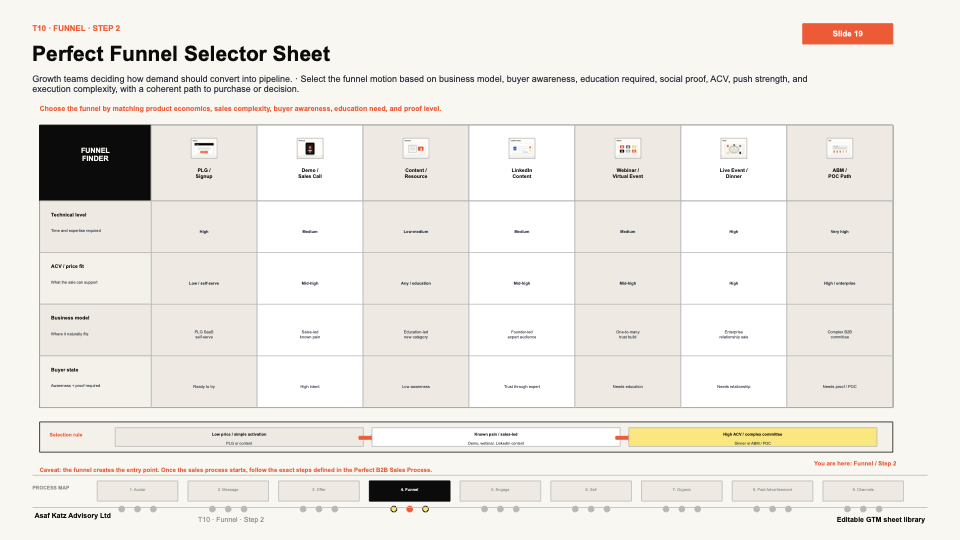
Does Hiring a GTM Engineer Replace a Demand Gen Agency?
No. And I want to be direct about why, because I have seen companies get this wrong.
A GTM engineer optimizes systems. They do not generate pipeline strategy, build relationships, or run the programs that put your company in front of buyers. They make your existing motion more efficient. They cannot create the motion from scratch.
If you have no pipeline motion, a GTM engineer will automate a system that produces nothing. AI amplifies whatever exists, including the broken parts. I have rebuilt the GTM foundation for over 40 companies, and the pattern is always the same: the companies that threw tools and automation at an unclear message and a weak offer got faster failure, not faster growth.
One of my own hard lessons fits here. My agency went from 20 clients to zero. The diagnosis: I was selling execution while the clients' real problem was foundation. Automation without foundation is just noise at scale.
If you have a strong event-led or ABM motion, a GTM engineer makes it dramatically more efficient by improving data quality, automating follow-up, and building better scoring models. Our AI-regulation webinar pulled 754 signups in 26 days, 100+ from target accounts, zero ads, and generated $180K in pipeline. A GTM engineer could take that motion and make the follow-up and scoring 10 times tighter. But the reason it worked was the topic selection and the trusted voice behind it. That is strategy, not infrastructure.
The event-led demand generation motion is the pipeline strategy. The GTM engineer helps run and measure it.
Even with a world-class GTM engineer on staff, you still need a reason for buyers to engage. Events are that reason. The system is what captures and converts the engagement.
Take the free 60-second check