What Is Buying Group Marketing? A Plain Definition for B2B Teams (2026)
Buying group marketing is the evolution of account-based marketing. Where ABM targets specific companies, buying group marketing goes one layer deeper: it targets every known and inferable stakeholder within those companies simultaneously, delivering role-specific content to each persona in the decision-making committee rather than treating the account as a single entity.
The core insight: in B2B, deals do not stall because one person said no. They stall because several people never said yes. Buying group marketing is the systematic approach to earning buy-in from the full committee before sales enters the room.
Why Buying Group Marketing Matters in 2026
B2B deals in 2026 involve an average of 10 or more stakeholders. That number has grown consistently for the past decade as enterprise purchasing has become more committee-driven, risk-distributed, and compliance-scrutinized.
The MQL model works like this: identify one contact who engages with marketing, hand them to sales. It fails this reality in two ways:
- The contact who downloads a whitepaper is rarely the person with final budget authority.
- Even if they have authority, they need internal buy-in from colleagues who never saw your marketing.
When I sold into pharmaceutical companies, the committee was everything. One enthusiastic champion was not enough. Compliance, legal, procurement, and the end user all had a seat. If any one of them stayed silent, the deal died quietly. I learned fast: you do not sell to a company, you sell to a process. Buying group marketing is that lesson, codified.
Buying group marketing solves this by treating the full committee as the unit of targeting. Every known persona at a target account receives content calibrated to their role, concerns, and decision criteria, simultaneously.
How Buying Group Marketing Works
The mechanics of buying group marketing in 2026:
Account identification. Select target accounts using signal data and ICP criteria. This is the same starting point as ABM.
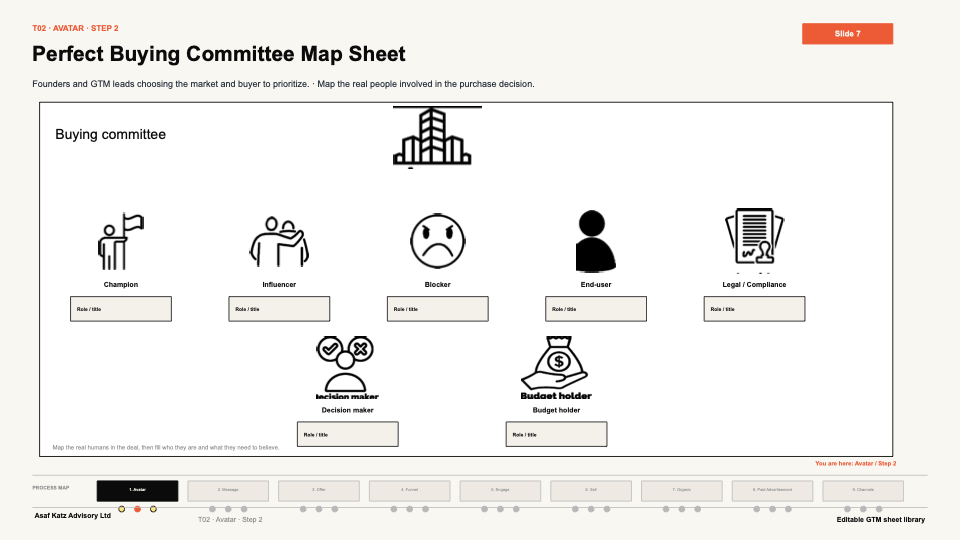
Buying group mapping. For each target account, identify known contacts and infer likely committee roles based on title, seniority, and department. A VP Engineering, Head of Security, and CFO at a fintech company are the likely committee for an infrastructure vendor. An AI layer maps them from your CRM and enrichment data.
Role-specific content activation. Each persona receives content tracks calibrated to their concerns. The CISO sees security and compliance content. The VP Engineering sees technical architecture content. The CFO sees ROI models and cost analysis. The content is different. The vendor message is consistent.
Live event convergence. The highest-performing buying group marketing programs use live events to bring multiple personas from the same account into one conversation simultaneously. A peer-led webinar around a topic the full committee cares about is the most efficient way to reach all stakeholders in one moment.
I structure events this way. I build a topic that resonates across committee roles: regulatory risk, infrastructure cost, AI governance. Then I invite all relevant personas from named target accounts. My live show, Risk Takers, draws 460 to 577 live senior attendees per episode, built from zero. Separately, one AI-regulation webinar pulled 754 signups in 26 days, more than 100 from target accounts, zero ad spend, and generated $180K in pipeline. The reason it worked: the topic was something buyers across the committee already wanted to discuss. That is buying group logic applied to event design.
For Kovrr, we rebuilt their enterprise story buyer-problem-first, matched content to each stakeholder's concern, and they closed 9 enterprise deals in one quarter. They needed 4 to hit their fundraising quota.
From My Own Work
The pattern I see most often: companies invest in ABM, pick the right accounts, and then send every message to the same one contact. Usually whoever replied first. The rest of the committee never hears from them. Sales shows up to a final meeting and discovers three new faces with three new objections. That is not a sales problem. It is a buying group coverage problem. Fixing it starts before the sales call, at the content and invite stage, by mapping who else sits in the room and reaching them on their own terms, with their own message, before sales ever dials.
Buying Group Marketing vs ABM vs Demand Gen
Demand gen creates broad awareness and captures inbound interest from whoever finds your content.
ABM narrows the target to specific high-value accounts and personalizes outreach at the account level.
Buying group marketing narrows further to the individuals within those accounts who make the decision, and activates simultaneous, role-specific engagement with all of them.
The three are complementary. Demand gen builds the surface area. ABM focuses the investment. Buying group marketing closes the consensus gap that kills deals at the committee stage.
One rule I apply before recommending any of the three: nobody earns the right to run a committee-level play until they know exactly who sits on that committee. If you cannot name the three to five roles that need to say yes, the buying group motion will not save you. Map the committee first. Then build the content. Then run the event.
Take the free 60-second check to see how this buying group approach works inside a done-for-you pipeline motion.