To fill a webinar with your ICP in 2026, pick the topic from signals your ideal buyers are already emitting, build a targeted invite list from named ICP accounts, and promote through warm reach, speakers, and partner channels. I ran one AI-regulation webinar that pulled 754 signups in 26 days, with 100+ from named target accounts, zero ad spend. The multiplier was simple: a subject buyers already wanted to discuss, with a voice they already trusted.
Why do webinars fill with the wrong audience?
Most webinars attract the wrong audience because the topic was picked internally and promoted broadly. A webinar titled "The Future of [Category]" sent to the full email list pulls whoever opens the blast, not the buyers who most need what you sell.
The wrong audience creates two compounding problems. Low attendance, because the topic does not resonate with people whose time is genuinely scarce. And low conversion to meetings, because attendees are not real buying candidates. The registration problem and the qualification problem share the same root cause: poor topic and audience selection at the very start.
How do you identify the right webinar topic for your ICP?
The right topic comes from listening to what your ICP is already discussing, not guessing what they should care about.
Three reliable sources:
- LinkedIn activity. What questions and frustrations do VPs and directors in your target industry post about? What topics generate engagement from your ICP contacts?
- Customer conversations. What do your best customers mention unprompted in quarterly reviews or onboarding calls? Recurring themes are your top candidates.
- Competitor content. What events are competitors running, and which generated visible engagement? Topics that work for adjacent products likely resonate with your shared ICP.
The right topic is specific, timely, and problem-shaped. "How fintech companies are preparing for DORA enforcement in 2026" outperforms "Regulatory Compliance for Fintech." Specificity signals that you understand what is live right now, not just the general category.
When I rebuilt Vendict's ICP and launched their webinar motion, we did not guess at topics. We listened first. Their VP Marketing told me later: "Our webinars got so popular we turned them into a podcast. Thousands of leads last year." That starts with topic selection, not production quality.
How do you build a targeted invite list for your ICP?
Prioritize quality over volume. A list of 1,500 well-targeted ICP contacts consistently outperforms 10,000 loosely matched ones.
The steps:
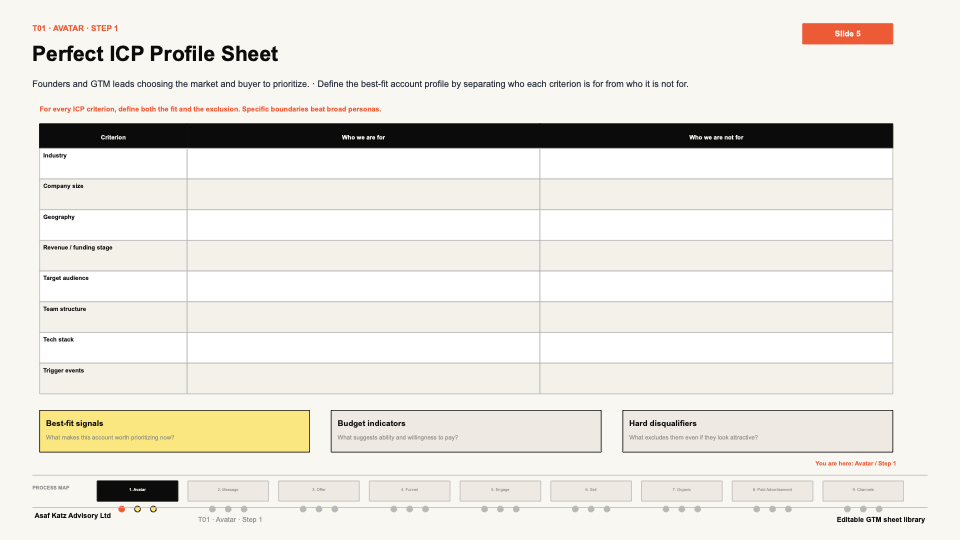
- Define your ICP by company size, industry, and persona, meaning title and seniority level.
- Build the list using Apollo, LinkedIn Sales Navigator, or Clay, filtering by firmographic and persona criteria.
- Enrich and score the list to prioritize best-fit accounts and suppress existing customers.
For an enterprise cybersecurity event, the list might be 1,200 CISO, VP of Security, and Head of Security personas at companies with 500 to 5,000 employees in financial services, healthcare, and technology. Not every security professional on the planet.
What does the invite message need to accomplish?
The invite message has one job: make the recipient believe attending is worth 60 minutes of their time. It does not need to explain your company history. It needs to answer one question: "What specific thing will I learn that I do not know now?"
A good invite structure: one sentence on the problem your ICP is navigating right now, one sentence on what they will specifically learn, the speaker name with a credibility signal, and one registration link. Short wins.
I track this across hundreds of campaigns. Event invites get accepted 40 to 50 percent of the time. Pitch outreach gets 5 to 10. Same lists. Same senders. The ask is the variable. A three-paragraph message that explains your company background before getting to the event loses most recipients before they reach the invitation.
What amplifies webinar signups beyond the initial email?
The invite email generates 60 to 70 percent of signups. The remaining 30 to 40 percent come from three reliable channels:
- Speaker LinkedIn posts. A speaker with a relevant following who posts about the event two to three weeks out can add 80 to 200 registrations. This is often the single highest-leverage signup driver.
- Team LinkedIn content. Posts from your founder or GTM leader framing the problem the event addresses warm up the audience before invitations arrive.
- Partner co-promotion. A complementary product or service that shares your ICP can promote the event in exchange for co-branding, lead sharing, or a speaker slot.
I also want to name a scenario most people avoid thinking about: things go wrong. A speaker change, a war, a forced reschedule. I watched all three happen at once for one client. We used the chaos to add 61 net-new registrations at zero cost and finished with 345 high-intent signups. Disruption is a promotion opportunity if you treat it that way.
My own live show, Risk Takers, draws 460 to 577 live senior attendees per episode. It was built from zero using the same principles: right topic, right list, right ask.
FAQ
Do I need a large existing list to get webinar signups? No. Targeted outreach to 1,500 well-qualified ICP contacts consistently outperforms broad blasts to 10,000 loosely matched contacts.
How far in advance should I promote a webinar? Start four to six weeks out. First invite four weeks before, second touch two weeks out, reminders at one week, 24 hours, and 60 minutes before the event.
What is a good webinar registration rate from ICP outreach? From cold ICP outreach, expect 3 to 8 percent to register. From a warm list, 8 to 20 percent. With a well-matched topic and speaker, targeted events can reach 20 to 30 percent on warm lists.
Should I include a product demo in the webinar? No. Events that feel like product demos attract fewer buyers and generate fewer meetings. The event should teach something genuinely useful. The product conversation happens in follow-up.
What is a realistic attendee-to-meeting conversion rate? With structured follow-up, 5 to 15 percent of attendees will agree to a meeting. A disciplined follow-up process consistently produces results at the upper end of that range.
How much does it cost to run a webinar targeting my ICP? Events start at $6,000, covering topic research, list building, production, speaker coordination, and post-event follow-up to book meetings from attendees.
Take the free 60-second check to see if your offer is ready.