Event Marketing for AI Companies in 2026: How to Turn Webinars Into Qualified Pipeline
AI companies face the most saturated vendor landscape in B2B in 2026. Every enterprise buyer is being pitched by dozens of AI vendors across every channel simultaneously. Event marketing for AI companies works when it breaks from the vendor-pitching format entirely and instead creates a live conversation that enterprise buyers actually want to attend.
The companies generating pipeline through events in the AI space are not hosting product demos. They are hosting peer conversations. Live sessions where CTOs, Heads of AI, and VP of Data roles from recognizable enterprises discuss real implementation challenges, organizational resistance to AI adoption, governance frameworks, and cost-of-failure scenarios. The vendor hosts. The vendor earns trust by facilitating, not by presenting.
What Type of Events Work for AI Companies in 2026?
The format hierarchy for AI company event marketing, from highest to lowest pipeline conversion:
Executive roundtables (10 to 30 attendees). Invite-only sessions with senior AI and ML leaders from named target accounts. High-touch, high-trust, long timeline. Best for companies targeting Fortune 1000 CIOs and CDOs.
Peer-led webinars (100 to 600 attendees). A CTO or Head of AI from a recognizable company presents a real implementation story. The vendor facilitates Q&A and is present as a resource, not a pitcher. My own live show, Risk Takers, runs on exactly this format. It draws 460 to 577 live senior attendees per episode, built from zero. The room fills because the content is worth attending, not because the vendor has a big logo.
Topic-specific micro-events (50 to 150 attendees). Tightly focused on a single AI challenge: governance, cost management, model evaluation, security. Smaller but highly qualified rooms because the topic specificity filters for buyers at exactly that stage. I ran one AI-regulation webinar that pulled 754 signups in 26 days, more than 100 from target accounts, zero ads, and generated $180K in pipeline. The reason it worked was simple: the topic was something buyers already wanted to discuss. We did not invent urgency. We found it.
Panel discussions and analyst Q&As. Good for building credibility in the AI space. Lower pipeline conversion than peer-led formats but a stronger brand authority signal.
One principle governs all of these formats. The Foundation comes before the funnel. Avatar, message, and offer must be sharp before you put 500 people in a virtual room. AI amplifies whatever exists, including the broken parts. If your positioning is fuzzy, a well-attended webinar just exposes that to more people at once.
How to Fill an AI Webinar With the Right Buyers
Filling a webinar with enterprise AI buyers is a targeting problem, not a promotion problem. Sending an email to a generic list does not work. Account-based event invitations to named ICP accounts do.
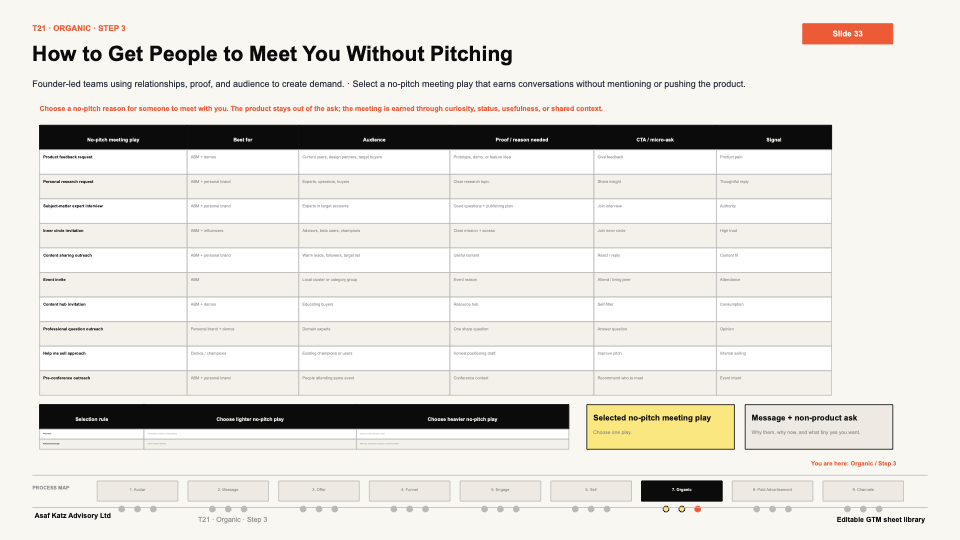
The data behind this is consistent across hundreds of campaigns I have run. Event invites get accepted 40 to 50 percent of the time. Pitch outreach to the same lists gets 5 to 10 percent. Same contacts, same senders. The only variable is the ask. An invite is not a pitch. It is an offer to join a conversation the buyer already wants to have.
The event invitation process for AI companies:
- Define the named account list. Typically 300 to 800 companies that match the ICP by vertical, size, and current AI maturity level.
- Identify contacts at each account by title and seniority using intent data and LinkedIn.
- Send a personally addressed invitation from a senior voice, not a company email, referencing a specific challenge the recipient's organization is likely facing.
- Follow up once before the event with a different angle.
- Record attendee behavior during the event: questions asked, time in session, resources downloaded. Use that data to score intent for follow-up.
The 754-signup webinar I mentioned above used exactly this process. One topic buyers already cared about, paired with a voice they already trusted, distributed to a targeted list with a genuine invite rather than a promotional blast.
The Follow-Up That Converts Attendance to Pipeline
The event itself is not the pipeline. The follow-up is.
I have seen well-attended events produce zero meetings because the follow-up was a generic thank-you email sent three days later. I have also seen a 200-person webinar produce 43 qualified meetings in 60 days because every follow-up was written from something that happened in the room.
AI company events convert to qualified meetings when the post-event outreach is:
Timely. Within 24 to 48 hours of the event, while the content is still fresh.
Personalized to in-event behavior. "You asked about governance frameworks during the Q&A. I have a specific resource and a 20-minute conversation in mind" converts better than a generic "thanks for attending" message. You are referencing what the buyer revealed about themselves. That is not a sales trick. It is basic respect for context.
Outcome-focused. The follow-up proposes a specific, narrow next step. Not a full demo. A 20-minute discussion of one specific challenge the attendee revealed is the right ask. Not a 60-minute sales call. The goal of the follow-up is a conversation, not a close.
One more thing worth saying plainly. Across every AI client I have worked with, the events that produce pipeline are not the most polished ones. They are the ones where the buyer felt seen, not sold to. That is the entire premise: create a room where the conversation is worth having, show up as a resource, and let the pipeline follow from trust rather than pressure.
Take the free 60-second check to see if this event marketing motion fits your enterprise ICP.